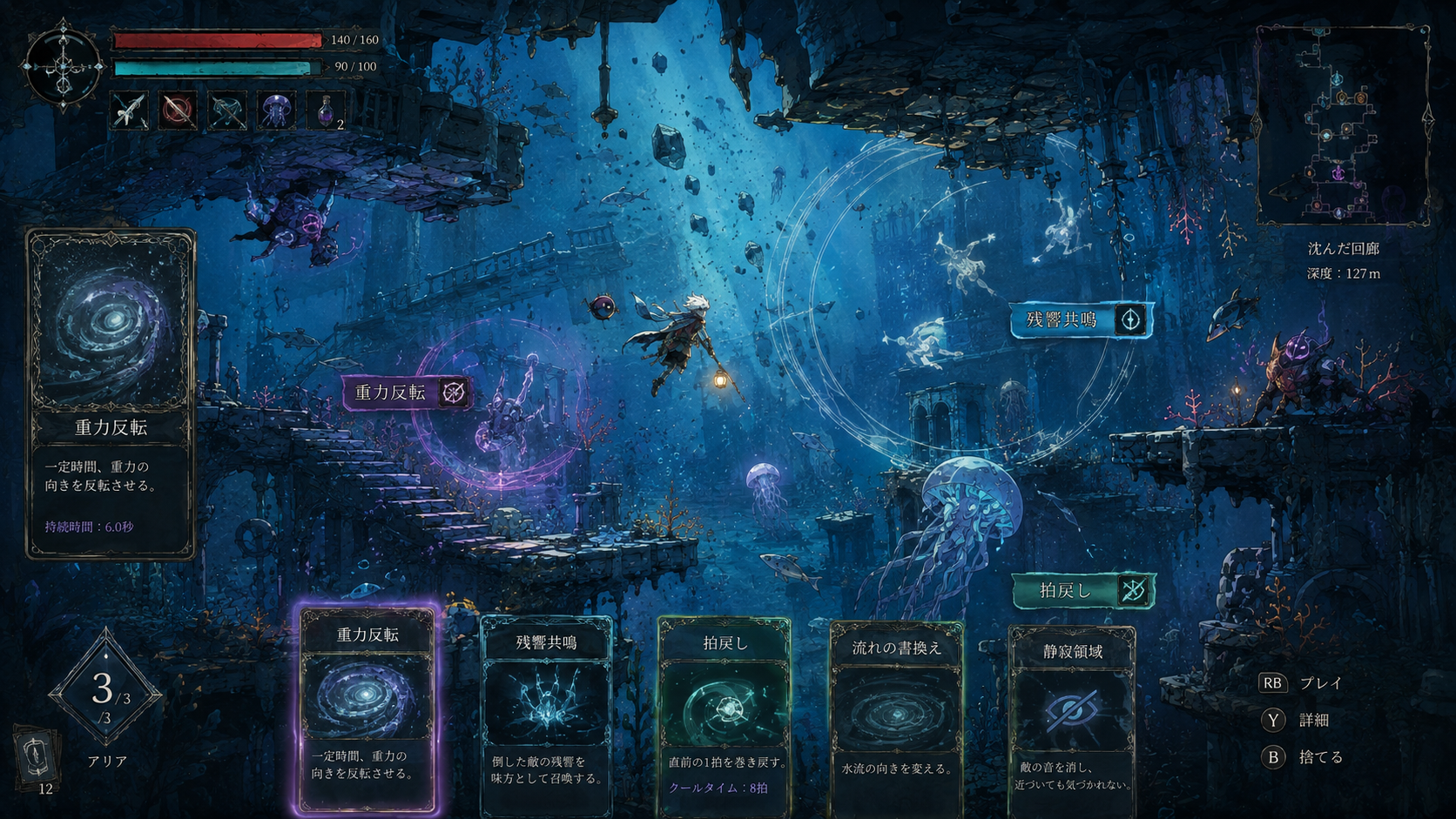
While implementing the first three layers for the trial version, I realized that the way underwater light was being rendered wasn’t working. I had tried to incorporate the real-world phenomenon where red light is lost as you go deeper—but the result was simply that the screen just became dark.
The reason for abandoning the two-pass approach
Initially, we rendered “color attenuation based on depth” and “water caustics fluctuations” as separate passes. While this approach was theoretically sound, it resulted in an average frame time exceeding 11ms on mid-range laptops—making a potential port to handheld consoles unfeasible.
Ultimately, we shifted to a design where the depth data is consolidated into a single texture, and the fluctuations are handled via vertex processing. This reduced the rendering load by approximately 40% and, in fact, helped the visuals blend better with the hand-painted backgrounds.
What is physically correct and what fits a hand-drawn image are two different things. My ultimate criterion is whether it “feels right” as a drawing.
Three proposals that were not adopted
- An approach involving a post-process pass to uniformly tone down colors was rejected, as it failed to allow for distinct visual treatments across different layers.
- An approach involving the creation of separate background assets for each depth plane was abandoned, as it tripled the workload and rendered production unfeasible.
- An approach using actual light sources was discarded, as it conflicted with the hand-painted shadows, resulting in a muddy, cluttered look.
In the next update, I plan to cover the generation rules for the fourth floor, “Corridor of Resounding Tides.” Please feel free to share your feedback or report any issues via Discord or X.